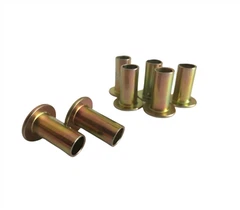


In the world of manufacturing and construction, rivets are indispensable fasteners that play a crucial role in joining materials together. As an OEM rivets supplier, I've witnessed firsthand the diverse applications and the importance of understanding the properties of these small yet mighty components. One of the most critical aspects of rivets is their impact resistance, which can significantly influence the performance and safety of the final products.
Understanding Impact Resistance
Impact resistance refers to a material's ability to withstand a sudden, forceful load without fracturing or deforming to an extent that compromises its functionality. For OEM rivets, this characteristic is of utmost importance, especially in applications where the fastened joints are subjected to dynamic loads, vibrations, or sudden shocks.
When a rivet experiences an impact, several factors come into play. The material composition of the rivet is the primary determinant of its impact resistance. Common materials used for rivets include steel, aluminum, copper, and brass, each with its own set of mechanical properties. Steel rivets, for example, are known for their high strength and excellent impact resistance, making them suitable for heavy - duty applications such as automotive and aerospace industries. Aluminum rivets, on the other hand, are lightweight and offer good corrosion resistance, but their impact resistance is generally lower than that of steel rivets.
The design and manufacturing process of the rivet also affect its impact resistance. The shape of the rivet head, the diameter and length of the shank, and the precision of the manufacturing all contribute to how well the rivet can handle impacts. For instance, Button Head Solid Rivets have a rounded head that distributes the load more evenly during an impact, reducing the stress concentration at the joint and enhancing the overall impact resistance.
Testing Impact Resistance
To ensure the quality and performance of OEM rivets, rigorous testing procedures are employed to measure their impact resistance. One of the most common methods is the Charpy impact test. In this test, a notched specimen of the rivet material is struck by a pendulum hammer, and the energy absorbed during the fracture is measured. The higher the energy absorbed, the better the impact resistance of the material.
Another test method is the drop - weight test, where a weighted object is dropped onto the riveted joint from a specified height. The joint is then inspected for any signs of damage, such as cracking or deformation. This test simulates real - world scenarios where the riveted structure may be subjected to sudden impacts.
Impact Resistance in Different Industries
Automotive Industry
In the automotive industry, OEM rivets are used extensively in the assembly of various components, including body panels, chassis, and engine parts. These rivets need to have high impact resistance to withstand the vibrations, shocks, and collisions that vehicles encounter during normal operation. For example, in the event of a minor fender - bender, the rivets holding the body panels together should not fail, ensuring the structural integrity of the vehicle.
Aerospace Industry
The aerospace industry has even more stringent requirements for rivet impact resistance. Aircraft are subjected to extreme forces during takeoff, landing, and flight, including high - speed airflows, turbulence, and potential bird strikes. Rivets used in the construction of aircraft wings, fuselages, and control surfaces must be able to withstand these forces without failure. A single rivet failure in an aircraft can have catastrophic consequences, so the impact resistance of aerospace - grade rivets is carefully engineered and tested.
Construction Industry
In the construction industry, OEM rivets are used in the assembly of steel structures, bridges, and building frames. These structures are often exposed to wind, seismic activity, and other external forces that can cause impacts. Rivets with high impact resistance are essential to ensure the long - term stability and safety of these structures. For example, during an earthquake, the rivets in a building frame need to maintain their integrity to prevent the collapse of the structure.
Advantages of High - Impact - Resistance Rivets
Using OEM rivets with high impact resistance offers several advantages. Firstly, it enhances the reliability and durability of the final product. Products that are assembled with high - impact - resistance rivets are less likely to experience joint failure, reducing the need for frequent repairs and replacements.
Secondly, it improves safety. In industries where safety is a top priority, such as automotive and aerospace, high - impact - resistance rivets can prevent accidents and ensure the well - being of users. For example, in a vehicle, a well - riveted joint can prevent parts from coming loose during a collision, protecting the occupants.
Finally, it can lead to cost savings in the long run. Although high - impact - resistance rivets may be more expensive upfront than their lower - quality counterparts, the reduced maintenance and replacement costs over the life of the product can offset the initial investment.
Our Role as an OEM Rivets Supplier
As an OEM rivets supplier, we understand the critical importance of impact resistance in different applications. That's why we are committed to providing high - quality rivets that meet or exceed industry standards. We use advanced manufacturing processes and state - of - the - art equipment to ensure the consistency and precision of our rivets.
Our team of experts conducts thorough material analysis and testing to select the most suitable materials for each application. Whether it's steel, aluminum, or other alloys, we ensure that the rivets we produce have the optimal combination of strength, ductility, and impact resistance.
We also offer a wide range of rivet designs to meet the specific needs of our customers. In addition to Button Head Solid Rivets, we have countersunk rivets, round head rivets, and other specialty designs. Our goal is to provide customized solutions that enhance the performance and reliability of our customers' products.
Engaging with Us for Purchasing
If you are in the market for high - impact - resistance OEM rivets, we would be delighted to engage in a purchasing discussion with you. Our team of dedicated professionals can provide in - depth product knowledge, answer any questions you may have, and offer tailored solutions to meet your specific requirements. Whether you are in the automotive, aerospace, construction, or any other industry, we have the expertise and products to support your needs. Contact us today to explore how our OEM rivets can contribute to the success of your projects.