
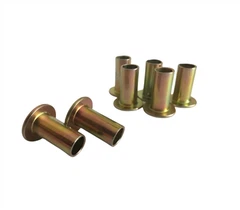



Do OEM rivets have a specific yield strength?
As an OEM rivets supplier, I often encounter questions from customers regarding the technical specifications of our products. One of the most frequently asked questions is whether OEM rivets have a specific yield strength. In this blog post, I will delve into this topic, exploring the concept of yield strength, its significance in the context of OEM rivets, and how it impacts the performance and application of these fasteners.
Understanding Yield Strength
Yield strength is a fundamental mechanical property of materials, including metals used in the manufacturing of rivets. It refers to the stress at which a material begins to deform plastically, meaning it will not return to its original shape after the load is removed. Before reaching the yield strength, the material behaves elastically, and any deformation is temporary. Once the yield strength is exceeded, the material undergoes permanent deformation, which can affect its structural integrity and performance.

The yield strength is typically measured in units of force per unit area, such as megapascals (MPa) or pounds per square inch (psi). It is determined through standardized testing methods, such as the tensile test, where a sample of the material is subjected to a gradually increasing tensile force until it begins to yield. The stress at which this occurs is recorded as the yield strength.
Yield Strength in OEM Rivets
OEM rivets, like all other types of rivets, are designed to provide a secure and reliable means of joining two or more components together. The yield strength of an OEM rivet is a critical factor in determining its ability to withstand the forces and loads it will encounter in service. A rivet with a higher yield strength can resist deformation and failure under greater stress, making it suitable for applications where high strength and reliability are required.
The specific yield strength of an OEM rivet depends on several factors, including the material from which it is made, its manufacturing process, and its size and shape. Different materials have different inherent yield strengths, with metals such as steel and aluminum typically having higher yield strengths than softer metals like copper or brass. The manufacturing process can also affect the yield strength, as processes such as cold working or heat treatment can increase the strength of the material.
In addition to the material and manufacturing process, the size and shape of the rivet can also impact its yield strength. Generally, larger rivets have higher yield strengths than smaller ones, as they have a greater cross-sectional area to resist the applied forces. The shape of the rivet head and shank can also affect its performance, with some designs being more suitable for specific applications than others.
Importance of Yield Strength in Rivet Applications
The yield strength of an OEM rivet is crucial in ensuring the safety and reliability of the assembled components. In applications where the rivet is subjected to high loads or stresses, such as in automotive or aerospace industries, a rivet with a low yield strength may deform or fail, leading to structural instability or even catastrophic failure. On the other hand, a rivet with a high yield strength can provide a secure and long-lasting connection, ensuring the integrity of the assembly.
Another important consideration is the fatigue resistance of the rivet. Fatigue is a phenomenon that occurs when a material is subjected to repeated loading and unloading cycles, causing it to weaken and eventually fail. A rivet with a high yield strength is more resistant to fatigue, as it can withstand the repeated stresses without deforming or cracking. This is particularly important in applications where the rivet is exposed to vibration or cyclic loading, such as in machinery or transportation equipment.
In addition to strength and fatigue resistance, the yield strength of an OEM rivet can also affect its installation process. A rivet with a high yield strength may require more force to install, which can impact the efficiency and cost of the assembly process. On the other hand, a rivet with a low yield strength may be easier to install but may not provide the same level of performance and reliability.
Determining the Appropriate Yield Strength for Your Application
When selecting an OEM rivet for your application, it is important to consider the specific requirements of the assembly, including the loads and stresses it will be subjected to, the environment in which it will operate, and the desired level of performance and reliability. The following factors can help you determine the appropriate yield strength for your application:
- Load and Stress Requirements: Consider the maximum loads and stresses the rivet will be subjected to in service, including static and dynamic loads. Select a rivet with a yield strength that is sufficient to withstand these loads without deforming or failing.
- Environmental Conditions: Consider the environmental conditions in which the rivet will operate, such as temperature, humidity, and exposure to chemicals or corrosive substances. Some materials may be more suitable for certain environments than others, and the yield strength of the rivet may be affected by these conditions.
- Assembly Process: Consider the assembly process and the equipment available for installing the rivet. A rivet with a high yield strength may require more force to install, which may require specialized equipment or additional labor.
- Cost and Availability: Consider the cost and availability of the rivet. Higher strength rivets may be more expensive, but they may also provide greater performance and reliability, which can result in long-term cost savings.
Our OEM Rivets and Their Yield Strengths
As an OEM rivets supplier, we offer a wide range of rivets made from different materials, including steel, aluminum, and brass, with varying yield strengths to meet the needs of different applications. Our Button Head Solid Rivets are a popular choice for many applications, thanks to their high strength, reliability, and ease of installation.
Our steel rivets are made from high-quality steel alloys, which provide excellent strength and durability. They have a yield strength ranging from 250 MPa to 800 MPa, depending on the specific grade and size of the rivet. Our aluminum rivets are lightweight and corrosion-resistant, with a yield strength ranging from 100 MPa to 300 MPa. Our brass rivets are known for their excellent electrical conductivity and corrosion resistance, with a yield strength ranging from 150 MPa to 300 MPa.
In addition to our standard rivets, we also offer custom-made rivets to meet the specific requirements of our customers. Our experienced engineering team can work with you to design and manufacture rivets with the exact yield strength and other properties you need for your application.
Conclusion
In conclusion, the yield strength of an OEM rivet is a critical factor in determining its performance and suitability for different applications. A rivet with a higher yield strength can provide greater strength and reliability, making it suitable for applications where high loads and stresses are expected. However, it is important to select the appropriate yield strength based on the specific requirements of the assembly, including the loads, environment, and assembly process.
As an OEM rivets supplier, we understand the importance of providing high-quality rivets with the right yield strength for our customers' applications. We offer a wide range of rivets made from different materials and with varying yield strengths to meet the needs of different industries and applications. If you have any questions or need assistance in selecting the right rivet for your application, please do not hesitate to contact us. We are here to help you find the best solution for your fastening needs.
References
- Callister, W. D., & Rethwisch, D. G. (2018). Materials Science and Engineering: An Introduction. Wiley.
- Shigley, J. E., Mischke, C. R., & Budynas, R. G. (2004). Mechanical Engineering Design. McGraw-Hill.
- ASM Handbook Committee. (1990). ASM Handbook, Volume 1: Properties and Selection: Irons, Steels, and High-Performance Alloys. ASM International.


