
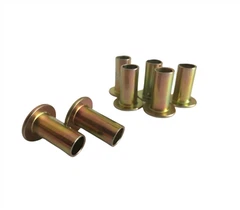



Hey there! As a supplier of Button Head Solid Rivets, I get asked a ton of questions about these little fasteners. One question that pops up all the time is, "What is the head diameter of button head solid rivets?" Well, let's dive right in and explore this topic together.
Understanding Button Head Solid Rivets
First off, let's quickly go over what button head solid rivets are. They're a type of mechanical fastener used to join two or more materials together. The "button head" part refers to the shape of the rivet head, which is rounded on top, kind of like a button. This shape gives the rivet a smooth and finished look, making it popular in applications where aesthetics matter, as well as in places where the rounded head won't catch on things.
The "solid" part means that the rivet is made from a single piece of metal, usually steel, aluminum, or copper. This makes them strong and reliable for a wide range of applications, from automotive and aerospace to furniture and electronics.
Factors Affecting Head Diameter
Now, let's talk about the head diameter. There isn't a one - size - fits - all answer to what the head diameter of button head solid rivets is because it can vary based on several factors.
Rivet Shank Diameter
The most significant factor is the diameter of the rivet's shank (the cylindrical part that goes through the materials being joined). Generally, the head diameter is proportional to the shank diameter. As a rough rule of thumb, the head diameter of button head solid rivets is typically 1.5 to 2 times the shank diameter. For example, if you have a button head solid rivet with a shank diameter of 3mm, the head diameter might be anywhere from 4.5mm to 6mm.
Industry Standards and Applications
Different industries have their own standards and requirements for rivet head diameters. In the aerospace industry, for instance, precision is key. Rivets used in aircraft construction need to meet strict specifications to ensure the safety and integrity of the aircraft. So, the head diameter of button head solid rivets in this industry will be very precisely controlled.
On the other hand, in less critical applications like some types of furniture assembly, there might be a bit more flexibility in the head diameter. As long as the rivet can hold the pieces together and looks okay, a slightly larger or smaller head diameter might be acceptable.
Material of the Rivet
The material of the button head solid rivet can also influence the head diameter. Softer metals like aluminum might be more forgiving during the riveting process, allowing for a bit more variation in the final head shape and diameter. Harder metals like steel, on the other hand, require more precise control during manufacturing to achieve the desired head diameter.
Common Head Diameter Sizes
Even though the head diameter can vary, there are some common sizes that you'll come across. Here are a few examples:
Small - Scale Applications
For very small button head solid rivets used in electronics or jewelry, you might find shank diameters as small as 0.8mm to 1.5mm. The head diameters in these cases could range from 1.2mm to 3mm. These tiny rivets are often used to join delicate parts together without causing too much damage.
Medium - Scale Applications
In automotive and general machinery applications, you'll often see shank diameters from 3mm to 6mm. The corresponding head diameters will be between 4.5mm and 12mm. These rivets are used to fasten various components, like brackets, panels, and small parts.
Large - Scale Applications
For heavy - duty applications in construction or large - scale manufacturing, shank diameters can go up to 12mm or more. The head diameters for these big rivets can be 18mm or larger. They're designed to handle a lot of stress and hold large, heavy - duty parts together.
Measuring the Head Diameter
If you need to measure the head diameter of a button head solid rivet, you'll need a good pair of calipers. Here's how you do it:

- Open the calipers wide enough so that you can place the rivet head between the jaws.
- Gently close the calipers until they just touch opposite sides of the rivet head. Make sure the calipers are perpendicular to the axis of the rivet shank.
- Read the measurement on the caliper scale. If you're using a digital caliper, it will display the measurement directly. If it's a manual caliper, you'll need to read the main scale and the vernier scale (if applicable) to get an accurate measurement.
Why Head Diameter Matters
You might be wondering why the head diameter of button head solid rivets is such a big deal. Well, there are a few reasons:
Load - Bearing Capacity
The size of the head affects the rivet's load - bearing capacity. A larger head diameter distributes the load over a greater area, which means the rivet can handle more stress without failing. This is especially important in applications where the joint will be subjected to heavy loads or vibrations.
Aesthetics
As I mentioned earlier, the button head shape gives the rivet a nice, finished look. The head diameter plays a role in this as well. If the head diameter is too small or too large for the application, it can look out of place. For example, in a piece of high - end furniture, you want the rivets to look proportional and blend in with the overall design.
Assembly and Installation
The head diameter also affects the assembly and installation process. If the head diameter is too large, it might not fit properly into the holes or recesses designed for the rivet. On the other hand, if it's too small, the rivet might not hold the materials together securely.
Contact Us for Your Button Head Solid Rivets Needs
If you're in the market for button head solid rivets, we've got you covered. Whether you need a specific head diameter for a custom project or standard sizes for a regular application, we can provide high - quality rivets at competitive prices.
We understand that every project is different, and we're here to help you find the right rivets for your needs. So, don't hesitate to reach out to us for a quote or to discuss your requirements. We're always happy to chat and find the best solution for you.
References
- Machinery's Handbook, 31st Edition
- ASME Standards for Fasteners
- Rivet Manufacturer's Technical Guides


